
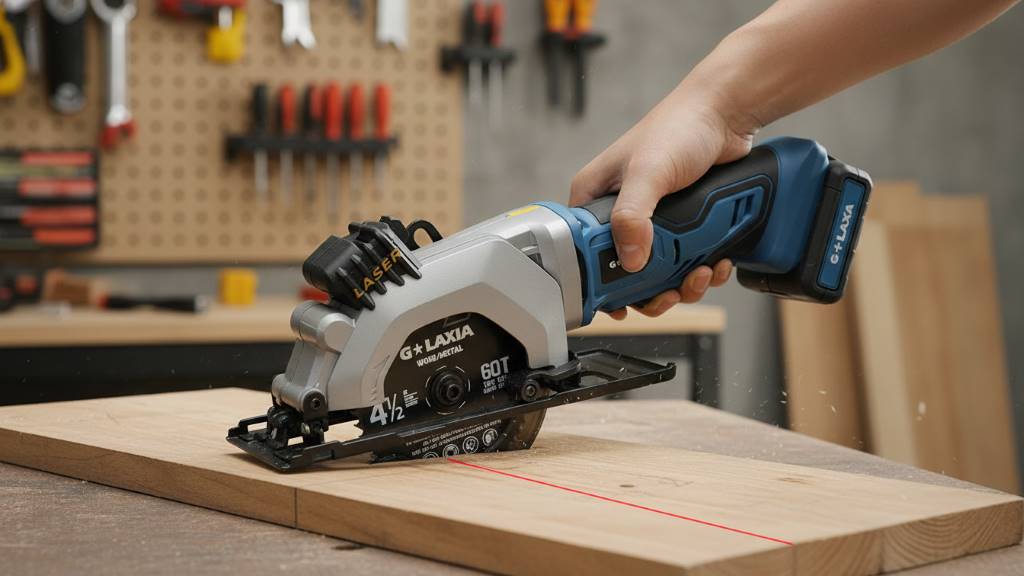
Choosing a mini saw sounds simple—until the first time a bulky tool fights you in a tight corner cut, or a “compact” saw still feels awkward after five minutes. That is exactly why so many DIYers and pros pay attention to the G LAXIA Mini Circular Saw: it aims to deliver real circular-saw capability in a smaller, easier-to-control format, without sacrificing the essentials that make cuts accurate and safe.
If you are researching a saw comparison, start here: portable saw comparison and then use the guide below to evaluate whether this model fits your materials, your workspace, and your typical cut types.
What makes a mini circular saw “best”?
A mini circular saw earns the “best” label when it solves the real problems users face with full-size saws—especially in cramped areas, small stock, and finish work—while still cutting cleanly, tracking straight, and staying predictable under load. Based on widely accepted industry standards for handheld saw performance and safety, the most important factors usually include:
- Stable base plate control and consistent tracking for straight cuts.
- Enough power and blade speed to avoid stalling and burning on common materials.
- Simple depth and bevel adjustments that stay locked during use.
- Visibility and guidance features that reduce guesswork (especially for beginners).
- Strong safety fundamentals: functioning guard, safe starting behavior, and good handling.
The G LAXIA Mini Circular Saw stands out because it checks many of these boxes while staying compact and approachable.
Compact size that actually improves control
Mini saws often claim “compact,” but the real win comes from control—especially when cutting installed materials, trimming panels, or working in narrow bays. The G LAXIA design focuses on a smaller form factor that helps guide the saw with less body movement, which matters when the workpiece cannot move (like baseboard repairs or in-place plywood patching).
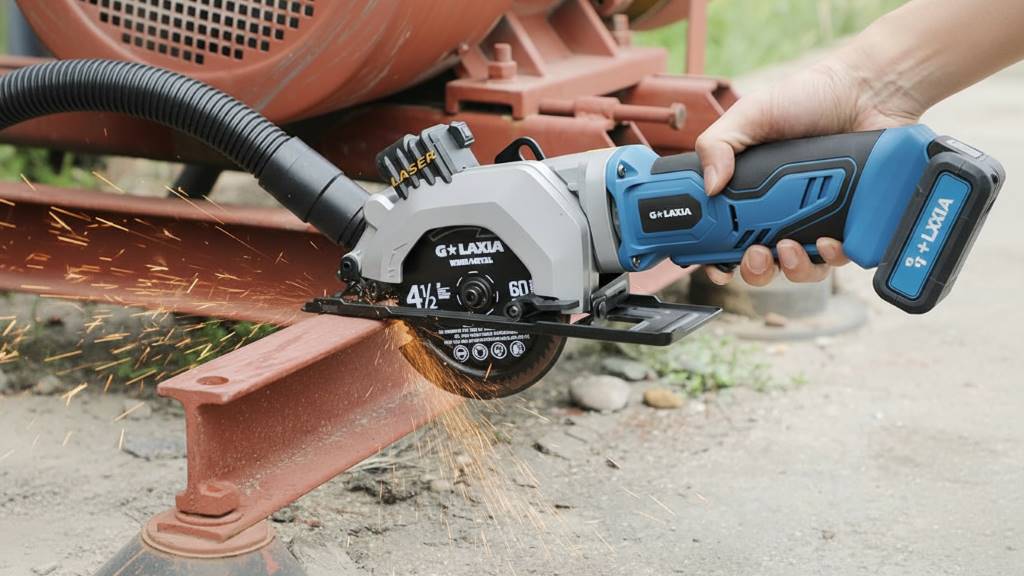
Why compact matters in real projects
A compact mini circular saw can make common jobs easier, including:
- Cutting plywood strips for shelving or cabinet fillers.
- Trimming laminate and thin boards without dragging out a large saw.
- Making quick cutouts where a jigsaw feels too slow or flexible.
- Working closer to edges and inside tighter spaces than a full-size saw allows.
That “smaller footprint” advantage becomes even more noticeable when the cut line must stay visible throughout the cut.
Strong cutting performance for a mini saw
Power-to-size ratio is one of the biggest reasons users choose this tool category. According to the saw’s manual specifications, this style of mini circular saw commonly runs at about 3500 RPM no-load speed and uses a 115 mm blade size with a maximum cutting depth around 42.8 mm at 90° and 28 mm at 45° (figures shown for the referenced mini saw manual) (based on manufacturer guidelines).
What that means for users
In practice, those specs translate into a tool that can handle:
- Sheet goods (plywood and similar panel products).
- Trim stock and dimensional lumber within its depth limits.
- Angled cuts for simple bevel needs (within its bevel range).
For a homeowner, that covers a surprisingly large percentage of weekend projects—especially when the goal is clean, controlled cuts rather than framing-speed production.
Accuracy helpers: laser guide + rip guide
Many people buy a mini saw for precision, then get disappointed when the saw wanders. The G LAXIA setup commonly includes two features that support straight, repeatable cuts: a laser guide and a rip/edge guide (based on manufacturer-style kits and common included components for this saw type).
Laser guidance for alignment
Based on manufacturer-style operating instructions, a laser can help align the saw with a marked cut line, especially at the start of the cut when the blade first bites into the material. It does not replace good technique, but it can reduce “starting drift” and make it easier to stay on your pencil line.
Rip guide for repeatable straight cuts
Manufacturer guidance for mini circular saws frequently recommends using a rip fence/straight edge guide when ripping for better accuracy and to reduce binding risk. A rip guide makes repeated parallel cuts far faster than measuring and freehanding every pass.
Depth and bevel adjustments that support clean results
Clean cuts depend on correct depth. According to manufacturer-style safety and operating guidance, blade depth should match the material thickness, and excessive depth increases the chance of kickback (based on manufacturer guidelines from a mini circular saw manual).
Practical setup tips (that users actually apply)
- Set depth so the blade extends only slightly below the workpiece.
- Re-check depth after moving between materials (plywood vs. 2x stock).
- Tighten locking levers firmly before starting the cut.
- For bevel cuts, confirm the base plate angle and lock it before cutting.
These habits matter more with mini saws because their smaller base can react faster if the blade binds or if the operator twists the tool.
Safer handling features for everyday users
A mini circular saw must feel predictable. According to widely accepted power-tool safety standards described in manufacturer manuals, safe operation depends heavily on fundamentals: guard function, stable grip, preventing unintentional starting, and avoiding kickback conditions (based on manufacturer-style safety instructions).
Safety elements that matter most
Based on standard circular saw safety rules described in owner manuals:
- Keep hands away from the cutting area and blade path.
- Support the workpiece properly to reduce binding and loss of control.
- Use appropriate PPE (eye protection, hearing protection, and dust protection as needed).
- Disconnect power before blade changes or adjustments.
- Avoid dull blades and forcing the saw, which can increase binding and kickback risk.
When the tool design supports a confident grip and controlled starts, users follow these rules more consistently—because the saw feels easier to manage.
Related:
Roof Vent Installation: Step-by-Step Guide for Existing Roofs (DIY & Pro Tips)
3-Inch Rigid Foam Board Insulation: A Comprehensive Guide
Dust control support for cleaner, more visible cuts
Dust ruins visibility, and visibility drives accuracy. Many kits for this saw category include a vacuum adaptor and a dust extraction port (based on manufacturer-style component lists and manuals). That matters because:
- Less dust on the line improves tracking.
- Less airborne dust improves comfort and cleanup time.
- Less debris around the guard area can help the guard move freely.
If cutting indoors or in finished spaces, dust management can be the difference between “quick job” and “full cleanup project.”
Versatility with multiple blade types
A major reason mini circular saws stay useful beyond the first project is blade flexibility. Manufacturer manuals for similar mini circular saws typically list multiple blade options for different materials—such as a TCT blade for wood and soft materials, an HSS blade for thin non-ferrous sheet metal, and a diamond blade for tile-like materials (based on manufacturer guidelines in a mini circular saw manual).
Practical advice for matching blade to job
As recommended by professionals:
- Use a wood-focused TCT blade for plywood, trim, and general lumber.
- Use a blade designed for metal only when the manual approves that material type.
- Use a diamond blade only for materials the tool and guard system can handle safely.
- Never “make do” with the wrong blade—this causes rough edges, overheating, and higher kickback risk.
Always confirm material compatibility in the manual for the exact model in hand.
A smart choice for tight-space woodworking and DIY
For many users, the best mini saw is not the one with the biggest marketing claims—it is the one that gets pulled off the shelf most often. A compact, lightweight circular saw style tool fits common real-world needs:
- Quick crosscuts without setting up a full station.
- Small panel sizing without wrestling a heavy tool.
- Repair work where a full-size circular saw feels excessive.
- One-person handling when working alone.
This tool type also helps beginners build skill because the smaller blade and compact housing can feel less intimidating than a full 7-1/4-inch saw—while still teaching correct circular-saw technique.
How to get the best results (actionable checklist)
Use this quick checklist for cleaner cuts and safer operation, based on manufacturer-style safety guidance and widely accepted best practices:
- Inspect the blade for damage or dullness before each session.
- Confirm the lower guard moves freely and closes fully.
- Set cutting depth correctly (avoid excessive blade exposure).
- Clamp the workpiece; never hold it in hand during cuts.
- Use a straight edge or rip guide for long rips.
- Start the saw before contacting the material; let it reach full speed.
- Maintain steady forward pressure—do not force the cut.
- Unplug/disconnect power before changing blades or adjusting settings.
These steps improve both finish quality and tool longevity.
FAQs
Is the G LAXIA Mini Circular Saw strong enough for plywood?
Yes for many plywood tasks, as long as the thickness stays within the saw’s maximum cutting depth and the blade matches the material (based on manufacturer guidelines for depth limits and blade selection in similar mini circular saw manuals).
Can a mini circular saw replace a full-size circular saw?
It can replace a full-size saw for many small-to-medium DIY cuts, but it will not match a full-size saw for deep cuts, long framing rips, or heavy production work (according to industry experts who separate “compact finishing” tools from “framing” tools by depth and duty cycle).
What is the biggest safety risk with mini circular saws?
Kickback and loss of control remain the biggest risks, especially if the blade binds, the workpiece closes the kerf, or the operator twists the saw during the cut (based on manufacturer-style kickback explanations in circular saw safety manuals).
Do laser guides guarantee straight cuts?
No. A laser helps alignment, but straight cuts still require a stable stance, correct depth, and either a guide/fence or strong technique (as recommended by professionals who treat lasers as “assist features,” not accuracy guarantees).
How should blade depth be set for safest cutting?
Set blade depth so only a small portion of the blade extends below the workpiece; excessive depth increases kickback risk (based on manufacturer guidelines in mini circular saw operating instructions).
Is this a good option as a lightweight circular saw for overhead or awkward cuts?
It can work well for awkward positions because compact tools reduce fatigue, but safe technique still requires stable footing, clear body positioning, and secure work support (according to widely accepted industry standards for handheld saw safety).
Conclusion
The G LAXIA Mini Circular Saw earns its “best mini saw” reputation by combining compact handling, practical accuracy aids, and everyday versatility in a tool that fits real DIY and light-pro workloads. If projects regularly involve plywood, trim, flooring underlayment, or tight-space cuts—and a full-size saw feels like overkill—this mini saw style can save time while improving control.
If adding one compact cutter to the toolbox this season makes sense, choose the blade for the material, set depth correctly, and commit to guided cuts whenever possible—then put the saw to work on a simple “first win” project like shelving, panel trimming, or repair patches.
References
- Mini Circular Saw Owner’s Manual & Safety Instructions (Model 766V-L): https://m.media-amazon.com/images/I/91xnXckwqzL.pdf
- Compact circular saw safety and operating manual (general circular saw rules): https://gzhls.at/blob/ldb/9/5/8/9/742629267b55d71413af238dcc4668917546.pdf
- Mini circular saw product specification listing (4A, 3500 RPM, 115 mm, included components): https://www.desertcart.sc/products/613317473-mini-circular-saw-4amp-3500rpm-corded-circular-saw-with-laser
You May Like

Can You Use Push Fit Fittings on Copper Pipe? What You Need to Know